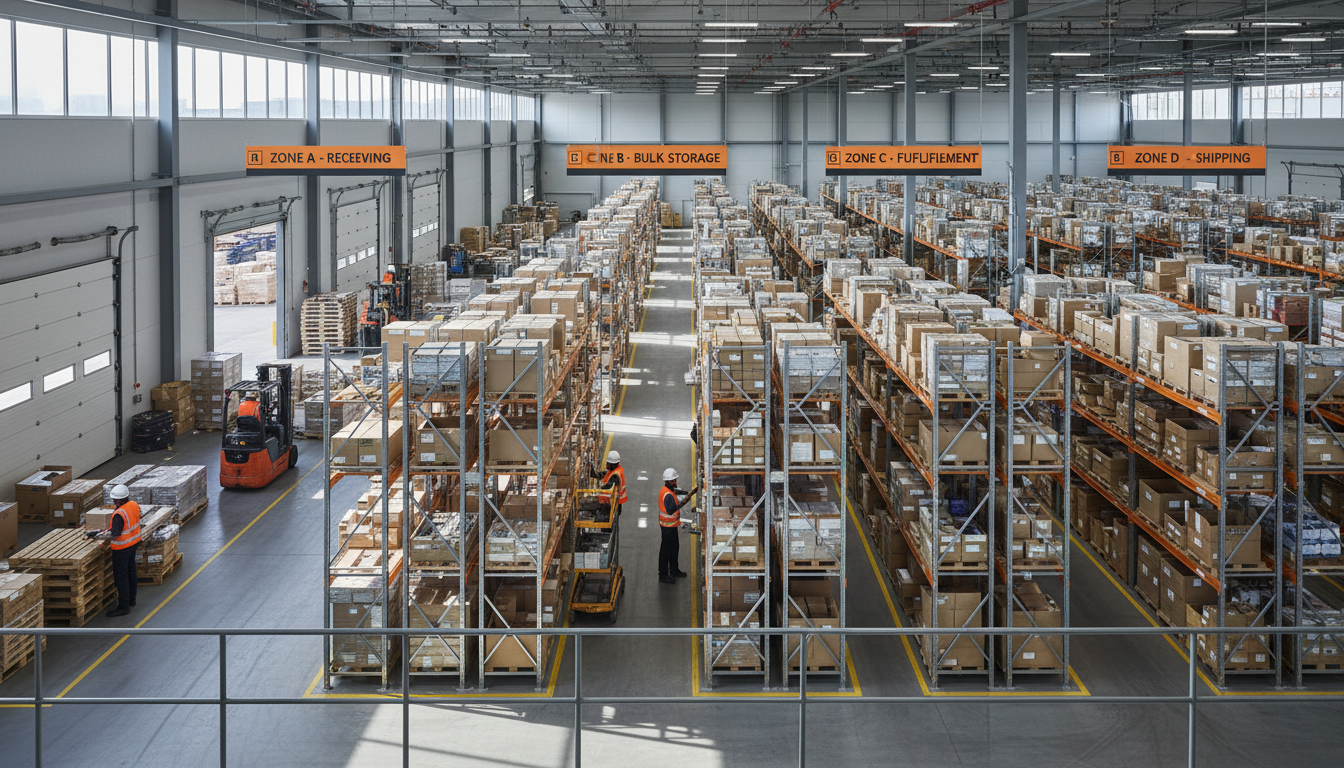
Optimizing a warehouse storage workflow requires maximizing vertical space through racking and implementing a Warehouse Management System to track inventory in real time. Small businesses should also map their space utilization and organize items based on accessibility to reduce errors and improve traffic flow.
In the world of logistics, a disorganized floor plan is more than a minor inconvenience; it is a silent drain on your bottom line. Many small businesses find themselves trapped in a cycle of misplaced inventory, redundant footsteps, and delayed shipments, all of which erode customer trust. At Duchesne Warehouse, we understand that your storage workflow is the heartbeat of your operational success. If the movement of goods is not fluid, your entire supply chain suffers. This guide provides a strategic roadmap to overhaul your internal processes. You will learn how to master precise receiving, implement intelligent slotting, and utilize the 5S methodology to maintain a high-performance environment. By the end of this article, you will have the actionable insights needed to turn your warehouse into a streamlined engine of growth and reliability.
Why Your Warehouse Storage Workflow Is the Engine of Your Business
A warehouse storage workflow is the deliberate sequence of physical movements and data logging that inventory follows from arrival to departure. For small businesses generating between $1,001 and $5,000 in monthly revenue, this workflow is the engine of the entire operation. Efficiency is not a luxury reserved for multi-billion-dollar corporations; it is a practical survival strategy for smaller retailers and manufacturers in Duchesne who must protect their margins.
When you implement reliable warehousing and storage solutions, you eliminate the chaos of misplaced items and delayed orders. A structured workflow directly supports accurate inventory management, ensuring that your digital storefront reflects your physical stock. This precision prevents the high costs of lost sales, backorders, or expedited shipping fees caused by fulfillment errors. By mapping out a clear path for goods, you reduce the time spent searching for products, which protects your most valuable asset: operational time.
The engine runs on five distinct stages:
Receiving: The precision handling of inbound stock.
Storing: Strategic placement and slotting for accessibility.
Picking: Efficient retrieval of items for open orders.
Packing: Preparing goods for safe transit and brand presentation.
Shipping: Coordinating with carriers for final delivery.
Optimizing each stage allows your supply chain to remain scalable, ensuring your operations can grow without becoming unmanageable.
Step 1: Receiving and Inspecting with Precision

A successful warehouse storage workflow begins the moment a truck hits the dock. For many small operations, the receiving area becomes a temporary graveyard for pallets that are not yet processed. Leaving stock in this transitional zone creates immediate bottlenecks and increases the risk of damage. You must treat the receiving dock as a high speed throughput area rather than a staging ground. The goal is to move items from the vehicle into your tracked inventory as quickly as possible, ensuring every unit is accounted for before it is moved to its storage location.
Immediate inspection is your first line of defense against financial loss. Verify that the quantity delivered matches the packing slip and inspect every carton for signs of transit damage. If you discover a discrepancy or a broken item, document it immediately. This allows you to resolve issues with suppliers or carriers before the product is lost within your facility. Once inspected, every item requires a clear label. Even if you do not use a complex Warehouse Management System (WMS), a methodical manual log or spreadsheet is essential. You must record the following data points for every arrival:
SKU or Part Number
Unit count per carton or pallet
Condition upon arrival
Batch or lot numbers for tracking expiration or quality control
Recording these details ensures accurate inventory management from day one. By logging condition and batch numbers immediately, you prevent downstream errors where damaged goods might accidentally be picked for an order. A disciplined receiving process transforms raw shipments into organized, saleable assets, setting the stage for efficient storage and retrieval.
Step 2: Strategic Storing and the Power of Slotting
Once your inventory is logged and labeled, it enters the storing phase. Strategic slotting is the practice of organizing products within your facility based on their turnover rates and physical characteristics. For small operations, this centers on the 80/20 rule: roughly 80 percent of your total sales volume likely stems from just 20 percent of your inventory. Identifying these high-velocity items is the foundation of a productive warehouse storage workflow.
Place your top 20 percent in the most accessible locations, specifically at chest height and as close to the packing station as possible. This area is often referred to as the golden zone. By positioning these items where they can be grabbed without a ladder or excessive bending, you significantly reduce the physical strain and travel time required for each pick. Slower moving items or bulk overstock should be moved to higher racking or the perimeter of the facility.
Maximizing vertical space is a key strategy we employ at Duchesne Warehouse to keep costs scalable for our clients. By utilizing height for goods that do not require daily access, we ensure that every square foot of prime floor space is dedicated to active fulfillment. This approach allows a growing business to maintain a lean physical footprint while still holding enough stock to meet seasonal demand.
Proper slotting ensures that when an order arrives, your team spends seconds, not minutes, reaching for the product. This organized layout serves as the essential bridge between accurate inventory management and the physical speed of your fulfillment team. When every SKU has a designated, logical home based on its sales frequency, you eliminate the guesswork that leads to delays and operational fatigue. Once these items are slotted correctly, you can begin to implement picking strategies that further compress your fulfillment timelines.
Step 3: Efficient Picking Strategies to Reduce Footsteps

After optimizing your slotting, the next stage of the warehouse storage workflow is the physical retrieval of goods. Picking often accounts for more than half of a warehouse facility’s total operating costs because of the cumulative time spent walking between racks. To minimize this drain on your margins, you must choose a picking strategy that matches your order volume and SKU density.
There are three primary methods to consider:
Discrete Order Picking: One order is picked from start to finish before moving to the next. While simple, it involves the most travel time.
Batch Picking: A picker collects items for multiple orders simultaneously. For a small business, this is often the most effective way to reduce footsteps; instead of walking to Aisle 4 ten times for ten different orders, the picker makes one trip to grab all required units.
Zone Picking: Pickers are assigned to specific sections of the warehouse and only pick items located in their zone. This is ideal for larger operations but may be overkill for modest inventories.
Efficiency in this stage depends entirely on the clarity of your aisle labeling. Every shelf and bin must have a unique alphanumeric code that corresponds precisely with your accurate inventory management logs. When the storing phase is handled correctly, the picker follows a logical, sequential path without ever needing to search for a product. Clear signage and floor markings bridge the gap between digital data and physical action, ensuring your team spends their time moving inventory rather than hunting for it. If you are struggling with a congested layout, you can contact our logistics team to discuss how scalable space can streamline your retrieval process.
Step 4: Professional Packing for Safety and Brand Identity
Once items are picked, they transition to the packing phase, a critical juncture in the warehouse storage workflow where inventory becomes a delivered brand experience. A dedicated packing station is essential for this transition. By centralizing supplies like tape, dunnage, and scales, you minimize movement and reduce the likelihood of forgetting an item from a multi-line order. A secure warehouse environment, like the one we maintain at Duchesne Warehouse, ensures that products arrive at these stations in pristine condition, free from the dust or environmental damage often found in unorganized facilities.
Choosing the right packaging is a balancing act between protection and profitability. Small businesses often lose margin by using oversized boxes that trigger higher dimensional (DIM) weight charges from carriers. Conversely, inadequate padding leads to costly returns and damaged reputations. You should standardize three to four box sizes that accommodate your most common order profiles. This standardization supports accurate inventory management by making shipping supply levels easier to track. Proper packing ensures that the physical integrity of the product matches the quality of your service, protecting your bottom line from the hidden costs of shipping errors and transit damage. By refining this stage, you ensure that the effort spent on efficient picking is not wasted by a preventable error at the shipping table.
Step 5: Shipping and the Final Fulfillment Loop
The shipping dock serves as the final gatekeeper of the warehouse storage workflow. To maintain order during peak hours, you should organize your outgoing staging area by carrier and service type. Assigning specific floor lanes or labeled bins for UPS, FedEx, and LTL freight prevents accidental cross-loading. For small businesses in rural Utah, this level of organization is particularly important; it ensures that when a driver arrives for a scheduled pickup, the transition is seamless and fast, reducing the time your dock remains congested.
Fulfillment is not truly complete until you close the data loop. Every outgoing shipment must be logged to reflect a reduction in on-hand stock. This feedback loop is the backbone of accurate inventory management, as it provides the real-time visibility needed to trigger reorders before a product reaches a critical low. Without this final synchronization, even the most organized physical space will eventually suffer from stockouts or over-ordering.
Operating in Duchesne requires a strategic approach to transit. Reliable logistics partnerships are the bridge between your local storage and a national customer base. By coordinating with regional carriers and maintaining a disciplined shipping schedule, you can achieve professional delivery standards that rival urban competitors. This final stage ensures that the efficiency gained during receiving and storing is carried all the way to the customer’s doorstep.
Applying the 5S Rule to Your Warehouse Organization

A clean environment is the foundation of a safe and efficient warehouse storage workflow. The Japanese 5S methodology provides a practical framework for maintaining high standards without expensive upgrades.
Sort: Clear your floor of anything that does not belong. Remove broken pallets, expired marketing inserts, or empty boxes that accumulate near the dock.
Set in Order: Create a logical layout where every tool has a home. Use inexpensive tape or floor markings to designate staging areas for accurate inventory management.
Shine: Schedule five minutes of cleaning at the end of every shift. Dusting racks and sweeping aisles prevents debris from damaging products or causing slips.
Standardize: Document these daily tasks on a simple clipboard. A consistent process ensures every team member follows the same organization rules.
Sustain: Conduct monthly walkthroughs to ensure the system remains intact.
By focusing on these five steps, small businesses reduce search time and eliminate the clutter that creates safety hazards. This disciplined approach keeps your daily operations predictable and your workflow moving smoothly.
Measuring Success: Essential KPIs for Small Warehouses
Refining your physical space through the 5S rule creates the foundation for a professional operation, but you must track specific data to prove your warehouse storage workflow is actually improving. For a small business in Duchesne, focus on three Key Performance Indicators (KPIs) that directly impact your bottom line.
First, track Order Cycle Time by recording the timestamp when an order is received and when it finally leaves the dock. A simple spreadsheet can calculate the average time per order, highlighting where specific bottlenecks occur. Second, prioritize Inventory Accuracy. Conduct monthly spot checks on high-velocity items and compare your physical count against your records to maintain accurate inventory management. Finally, monitor Picking Accuracy by logging any shipments returned due to incorrect items. Divide the number of error-free orders by your total order volume to find your percentage. These metrics do not require expensive software. A dedicated clipboard at the packing station or a basic digital log provides the visibility needed to scale your operations effectively. If these metrics reveal consistent delays, you may need to contact our logistics team to explore more scalable space options.
Optimizing your storage workflow is more than just moving boxes; it is about creating a sustainable system that grows alongside your business. By implementing these strategies, you can reduce errors and improve overall productivity. If you find that managing these logistical challenges is becoming too complex to handle alone, professional support can provide the clarity you need. To see how we can assist your growth, feel free to learn more About our history and professional approach. We are here to support your success.