
Efficient warehouse small parts storage requires a combination of high-density shelving, labeled bins, and automated retrieval systems to maximize floor space and pick accuracy. Businesses must integrate these physical storage solutions with digital inventory tracking to maintain real-time visibility and prevent stockouts. This holistic approach reduces picking errors while streamlining the organization of fasteners, electronics, and other miniature components.
For many Utah manufacturers, the difference between a high yield shift and a costly bottleneck often comes down to the smallest components in the facility. A missing fastener or a mislabeled bracket can halt an entire assembly line, leading to wasted labor hours and delayed deliveries. Managing thousands of distinct SKUs requires more than just extra shelving; it demands a strategic approach to spatial organization and inventory accuracy. In this guide, we will explore the most effective physical storage systems for small parts and the 80/20 rule for hardware management. We will also compare manual and digital tracking methods to help you determine the best fit for your current scale. By implementing these professional labeling standards and reorder strategies, you can transform your warehouse from a source of friction into a streamlined engine of production.
Why Small Parts Create Big Bottlenecks for Utah Manufacturers
In Duchesne, local manufacturers often find that their biggest delays do not come from a lack of raw lumber or steel plate, but from a missing bag of fasteners, a specific hydraulic fitting, or a misplaced electrical seal. While large pallets and heavy equipment are difficult to lose, small components are easily overlooked, buried under larger stock, or accidentally over-ordered because the count was unclear. This creates a significant bottleneck; a thousand-dollar project can sit idle for days simply because a five-cent part is missing.
For businesses transitioning from a home garage or a crowded workshop to a professional scalable warehouse space, the shift requires moving beyond basic shelving. Maintaining accurate inventory management for thousands of tiny units requires a different level of discipline than managing bulk goods. Without a dedicated system for warehouse small parts storage, these items often become invisible inventory. They occupy physical space and tie up capital, yet they fail to be available when the assembly line needs them most. If a disorganized workshop is currently slowing down your fulfillment, it may be time to contact Duchesne Warehouse to discuss how a structured environment can eliminate these small-scale logistics headaches and keep your production moving.
Physical Organization: Best Warehouse Small Parts Storage Systems
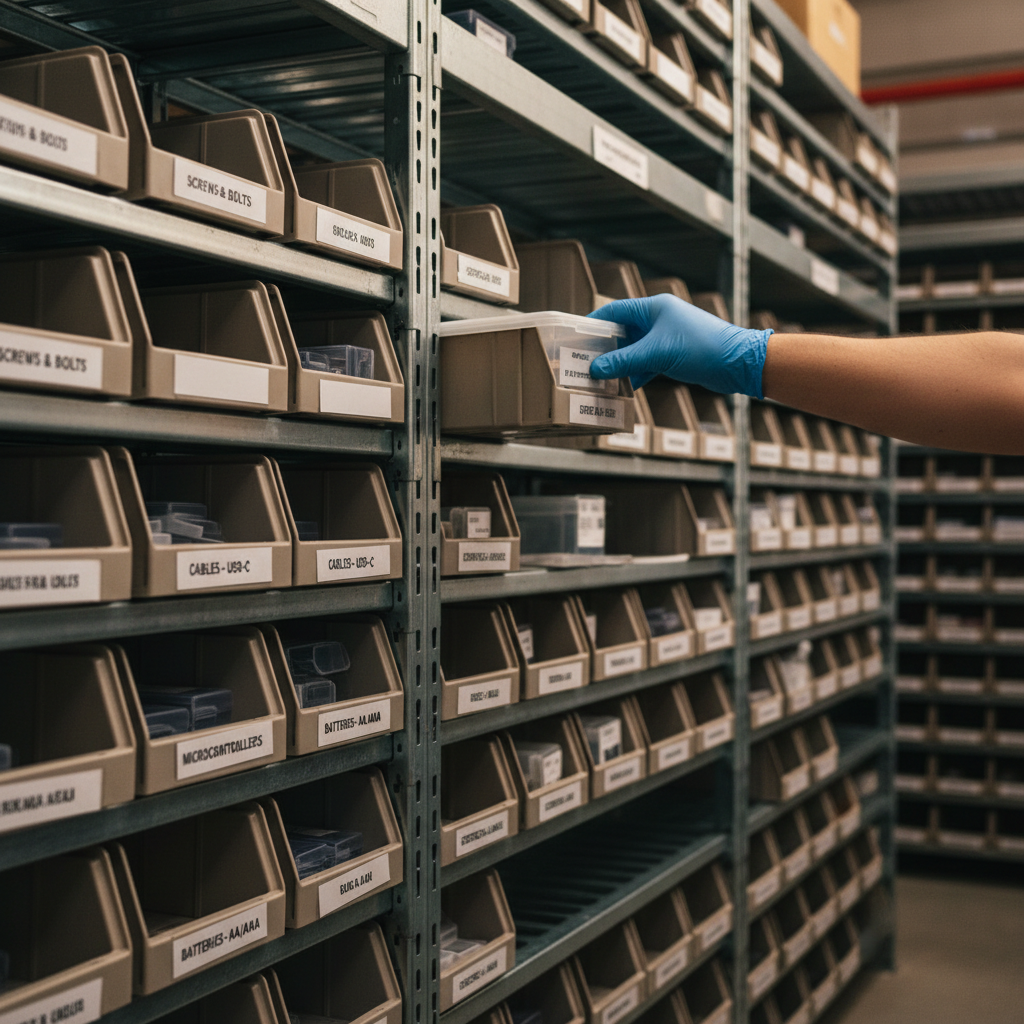
Moving from makeshift setups to a professional warehouse environment requires selecting equipment that matches the volume and velocity of your specific components. The goal is to maximize SKU density while minimizing the time spent locating and retrieving individual items. In a professional warehouse small parts storage setup, the physical layout must balance protection for delicate items with the speed required for modern fulfillment.
Storage Method | Best Use Case | Key Advantage |
|---|---|---|
Open-Front Plastic Bins | Fast-moving assembly parts | High visibility and easy hand-picking |
Industrial Drawer Cabinets | Tiny hardware and sensitive seals | Maximum density and dust protection |
Standard Vertical Shelving | Bulkier small parts and overstock | Flexible height for various bin sizes |
Local manufacturers often ask, "What is the best small parts organizer system?" The reality is that a hybrid approach is usually the most effective solution. High-frequency items, such as common fasteners or gaskets, perform best in open-front plastic bins situated on reachable shelving levels. These bins allow workers to see stock levels at a glance, supporting accurate inventory management without requiring them to open a drawer for every pick. Conversely, very small or expensive items, like specialized electronic components or precision O-rings, are better suited for industrial drawer cabinets. These cabinets prevent items from being lost in the back of a shelf and utilize every cubic inch of space.
In a small storage warehouse, maximizing the footprint is critical. Vertical shelving serves as the skeleton for all other systems. By extending storage upward, businesses can increase their capacity without the need for additional square footage. Utilizing scalable warehouse space effectively means looking at the verticality of the facility; even a standard 12 foot shelf can hold three to four times the inventory of a traditional workbench if configured with the right combination of drawers and bins. This structured physical organization ensures that every square foot of the facility contributes to operational efficiency rather than becoming a cluttered bottleneck.
The 80/20 Rule for Hardware and Component Inventory

Effective warehouse small parts storage relies on the Pareto Principle, commonly known as the 80/20 rule. In an industrial setting, this principle suggests that roughly 20 percent of your small parts, such as common bolts, standard seals, or frequently used fittings, will account for 80 percent of your daily picking activity. Identifying these high-velocity items allows a business to prioritize their placement within the facility to maximize accurate inventory management efficiency.
To optimize these workflows, these high-demand components should be stored in the "golden zone." This is the area between chest and eye level on your racking systems. By placing the most active 20 percent of your inventory in this zone, you minimize the need for employees to reach, bend, or use ladders for the majority of their tasks. This strategy significantly reduces physical strain and cuts down on the cumulative seconds lost during each pick, which translates to faster fulfillment times and lower operational costs. For businesses utilizing scalable warehouse space, applying the 80/20 rule ensures that high-turnover hardware remains at the forefront of the operation while slower-moving items are moved to higher or lower shelves. Organizing inventory by velocity rather than just part number is a hallmark of a professional, high-functioning supply chain.
How to Keep Track of Inventory for Small Business: Manual vs Digital

Once the physical placement of hardware is established using the 80/20 rule, the focus shifts to data integrity. A common question for growing Utah companies is how to keep track of inventory small business owners can manage without overwhelming their staff. The choice between manual logs and digital systems often depends on the daily volume of picks and the complexity of the assembly process.
Feature | Manual (Spreadsheet) | Digital (Barcoding) |
|---|---|---|
Setup Cost | Very Low | Moderate |
Error Risk | High (Manual entry errors) | Low (Scan confirmation) |
Scalability | Limited to low SKU counts | High; grows with business |
Speed | Slower; requires typing | Rapid; point-and-click |
Manual tracking via spreadsheets is often the starting point for businesses recently moved into scalable warehouse space. If choosing this route, the spreadsheet must be structured for absolute clarity to maintain accurate inventory management. A functional inventory sheet should include these specific columns at a minimum: Part ID (Unique SKU), Description (Detailed name and size), Bin Location (Rack/Level/Bin), and Minimum Stock Level. The Bin Location column is particularly vital for warehouse small parts storage, as it directs the picker to the exact coordinate in the facility, reducing search time.
While manual entry is cost-effective for very small operations, it remains susceptible to human error during high-velocity fulfillment. Digital systems utilizing basic barcoding eliminate the need for manual typing. By scanning a barcode on a storage bin and then a corresponding pick sheet, a worker confirms the correct item is being pulled in real-time. This digital handshake ensures that the physical count in the warehouse always matches the digital records. For manufacturers dealing with hundreds of similar-looking fasteners or fittings, a simple barcode scanner acts as a safeguard against shipping the wrong thread pitch or material, protecting the bottom line from costly returns and production delays.
Labeling Standards and Warehouse Racking Safety
Implementing digital tracking requires a physical environment that mirrors the digital record through precise labeling. For a professional warehouse small parts storage system to function, every bin and shelf must follow a standardized alphanumeric labeling convention. A typical coordinate system might identify the zone, aisle, rack section, and shelf level, such as A-04-B-02. This specificity allows staff to navigate scalable warehouse space with surgical precision, reducing the time spent searching for a particular fitting or fastener. Labels should be high-contrast, typically black text on white or yellow backgrounds, and placed consistently on the front face of every bin to ensure scanners can capture them without shifting inventory.
Beyond organization, physical safety is a non-negotiable aspect of facility management. Maintaining warehouse racking safety ensures that storage systems remain stable under load and compliant with OSHA standards. Even when dealing with seemingly light small parts, the cumulative weight of thousands of steel fasteners or hydraulic components can quickly exceed a shelf's rated capacity. A fundamental safety guideline is to store the heaviest bins on the bottom levels. This lowers the center of gravity for the racking unit and prevents the top-heavy conditions that lead to rack failure or tipping.
Regular inspections for bent uprights or missing safety pins are essential; even minor structural compromises can lead to collapses in a high-density environment. Prioritizing these standards ensures accurate inventory management occurs in a secure environment. If your current storage setup feels precarious or disorganized, you can contact Duchesne Warehouse to discuss professional solutions that prioritize both safety and workflow efficiency.
Managing Your Bill of Materials and Reorder Strategies
Safety and labeling provide the framework, but the logic governing when you restock is what keeps production lines moving without interruption. For Utah manufacturers, the most effective warehouse small parts storage is one directly linked to a Bill of Materials (BOM). A BOM acts as the master recipe for your product; it lists every nut, bolt, and seal required for assembly. By mapping your storage bin locations to these specific BOM line items, you ensure that every part is accounted for long before the first technician reaches for a tool.
Maintaining accurate inventory management requires setting firm par levels for every SKU. A par level is the minimum quantity of an item that must be on hand to meet demand while a replacement order is in transit. To calculate a reorder point, multiply your average daily usage by the lead time, then add a safety buffer for shipping delays. This data-driven approach prevents the stockout crisis where a five-cent part halts a five-figure shipment.
Component Type | Usage Rate | Lead Time | Reorder Point (Par Level) |
|---|---|---|---|
Standard Fasteners | High | 3 Days | 500 Units |
Custom Seals | Low | 14 Days | 50 Units |
Critical Fittings | Medium | 7 Days | 100 Units |
If managing these thresholds alongside daily production feels overwhelming, moving to a scalable warehouse space with integrated tracking can provide the oversight needed. A well-executed reorder strategy ensures that the bin is never truly empty; it allows your business to scale without the friction of manual count checks. To optimize your component logistics and secure your supply chain, you can contact Duchesne Warehouse for professional support in organizing and managing your critical inventory.
Mastering the art of small parts storage is essential for any growing business seeking operational efficiency. By implementing structured tracking systems and smart organization, you set a strong foundation for future success. If you want expert help navigating these logistical challenges, you can find more information about our team and our approach to storage. We understand that every inventory requirement is unique; our specialists are here to support your growth with professional insights tailored to your specific operational needs.